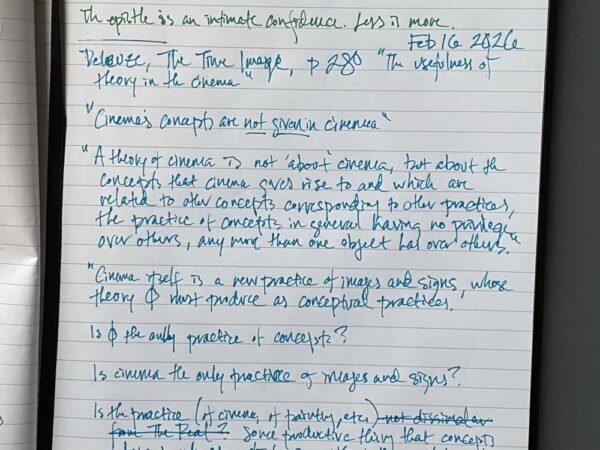

Cinema 2: The Time Image, p. 280.
“The usefulness of theory in cinema”
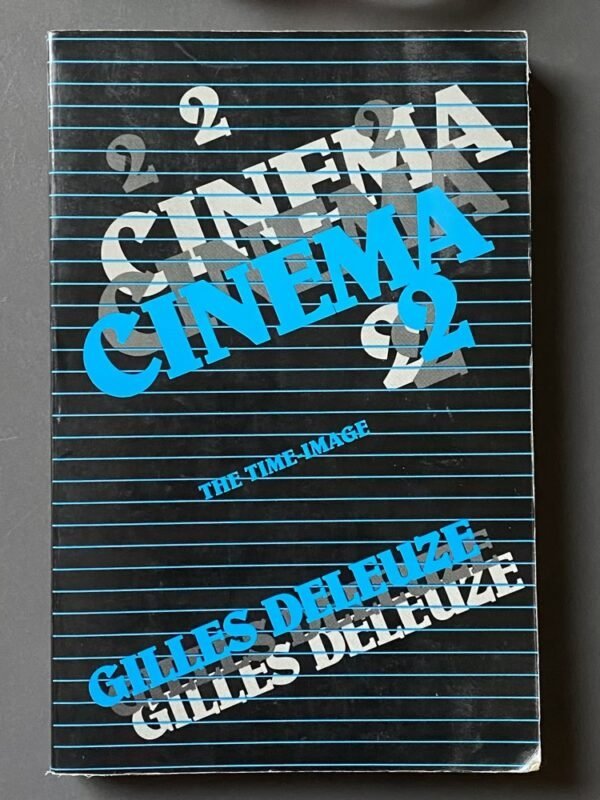
Who first introduced me to the French philosopher Gilles Deleuze (1925-1995)
My relationship with Deleuze goes back to 1994? I was a senior at the College of Wooster and my roommate that year was Matthew Tunno. Matt was one of those people who charmed everyone. He was a philosopher major; I was just beginning my training in philosophy, and it was probably he who introduced me to Deleuze.
Have you read the Cinema books cover to cover?
The Time Image, like The Movement Image, I have never read systematically. I’ve read it here and there. I suppose this is peculiar, given my extraordinary interest in both philosophy and cinema.
The Time Image is the second book on Cinema.
Would I say that this book is describing the second of two regimes of cinema practices (the first being “the movement image” and the second being …), chronologically distinguished by the Second World War?

“The usefulness of theory in cinema”
This passage is at the end of the two volumes, and so it effectively a final statement on all of what he’s said to this point. In the table of contents it is given the title “The usefulness of theory in cinema”
Cinema’s concepts are not given in cinema.
Who do these concepts belong to?
A theory of cinema is not ‘about’ cinema, but about the concepts that cinema gives rise to end which are related to other concepts corresponding to other practices — the practice of concepts in general having no privilege over others, more than one object has over others.
So they belong to philosophy?
Cinema itself is a new practice of images and signs, whose theory philosophy must produce as conceptual practice.
Philosophy is a practice of concepts, yo!
Is philosophy the only practice of concepts?
Of course not!
Is cinema the only practice of images and signs?
Noch einmal!
Is the practice (of cinema, of painting, etc.) some productive thing that concepts relate to only at a distance, without the possibility of interference?
Hmmm, good question!
Writing these words at the end of two books on cinema is Deleuze’s way of saying, this is not an ontology of cinema!