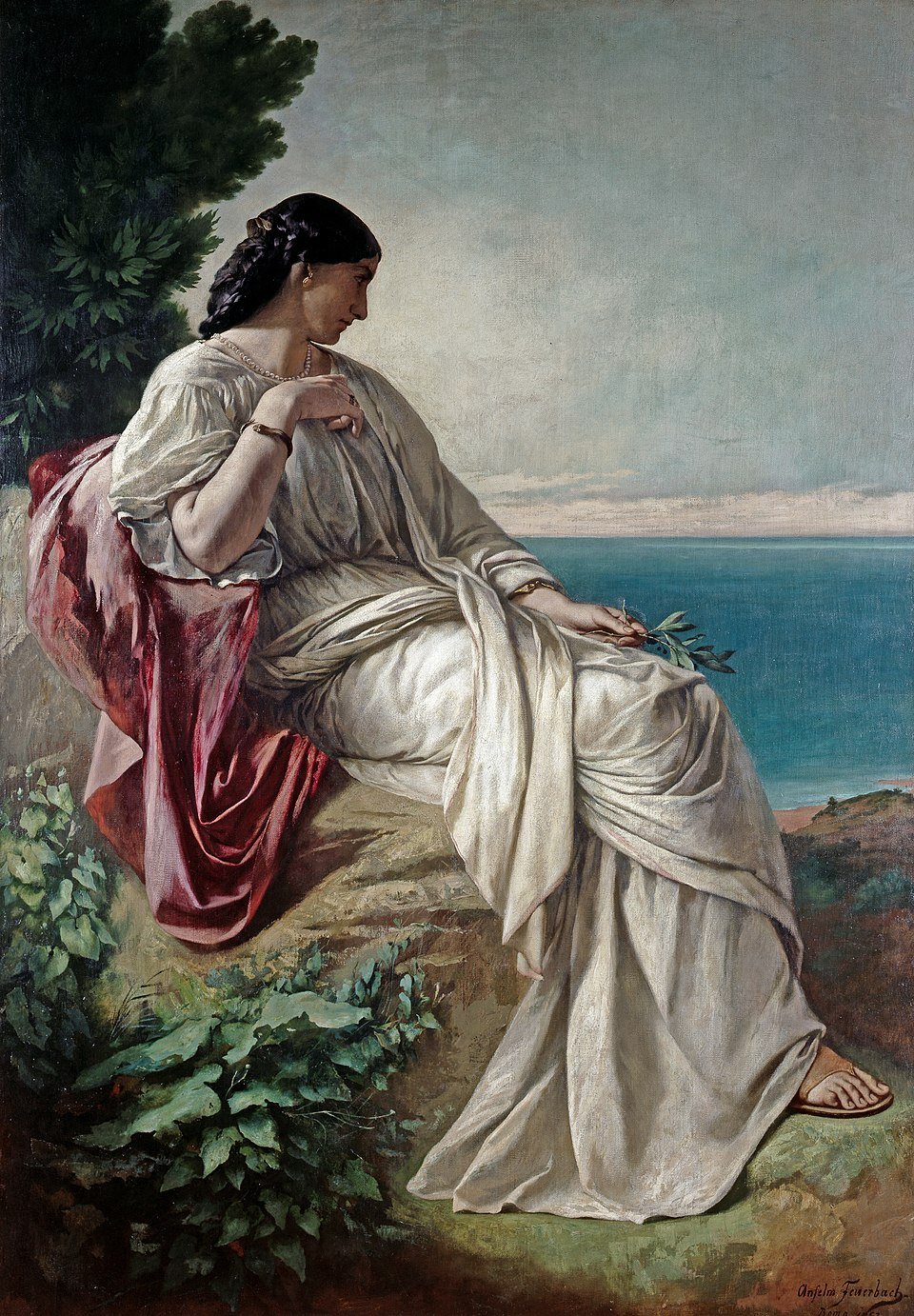
The 1862 painting "Iphigenia" by the 19th-century German painter Anselm Feuerbach.
Was I curious about human sacrifice, about why the sacrifice of a daughter would be acceptable? I guess I though, how could this happen?
In what way would this deed be acceptable. And I suppose that’s a question that I’ve answered below.
Why must Iphigenia be sacrificed? Why not Helen’s daughter Hermione?
This is a question posed in the play. The answer is that Agamemnon offended Artemis, so the story goes, and this is why a sacrifice personal to Agamemnon must be made.
In order for Menelaus and Agamemnon to amass the legions of Greeks who would go to war, they were forced to go and see the kings and leaders of each city-state and convince them to enter into an alliance, to go with them to war.
Remember that these are city-states that do not naturally exist in harmony with one another. To the contrary, the Greeks watching Euripides’ performance knew only too well that these city-states existed in a continual tension punctuated by military campaigns, destruction.
A pan-Greco alliance, therefore, was a unique, amazing thing.
At Aulis all of these generals/kings had assembled the hundreds of men and the scores of triremes. Men had said tearful goodbyes to their wives and families, without any guarantee of return.
But then the sailing conditions were poor. So they stayed on the coast, waiting for the weather to be advantageous. Waiting, and waiting.
They would do anything to begin the maritime journey, for each day brought the threat of cities and kingdoms that would abandon the cause and weaken the Greek army. Menelaus and Agamemnon were under tremendous pressure.
So they consulted an oracle and learned that Agamemnon would sacrifice his daughter Iphigenia before they could make their departure.
The Formulation of the Oracle
Note the way that I wrote this:
Not: if they wanted to go, Agamemnon would have to sacrifice his daughter.
This implies possibility and corresponds to the way that we generally conceive our actions. They are free actions, but each action comes with consequences. But that no action is necessitated.
Instead: before their departure, Agamemnon will sacrifice Iphigenia.
This formulation accords with the notion of an oracle, of a prophecy. It’s not if this, that. It’s this, then that. Something is necessary, then another thing is necessary. One thing will proceed another thing.
So Agamemnon calls his daughter to Aulis to make her the bride and queen of Achilles.
When the Play Begins
Before Iphigenia arrives, he begins to have doubts.
This is where the play begins, with Agamemnon writing and rewriting a letter to his daughter to be delivered to her on the road to Aulis, begging her to return home. He dispatches a messenger with this communication.
Despite this, the message is intercepted by Menelaus. Furious Menelaus.
Although I think little of this play is actually about Iphigenia herself, despite being the title character, the emotional and ethical stations through which she moves are nothing short of amazing.
She begins the play as a king’s daughter, jubilant that she is being joined in matrimony with Achilles, the famous king of Phthia, son of a goddess, and possibly the most amazing warrior of all times (although Troy would burnish this reputation more than anything). Her life is reaching a climactic moment.
But it becomes clear that she had been deceived and no such union would take place. Achilles doesn’t even know that his name has been used in this matter, and Iphigenia suffers the embarrassment of believing that she was about to marry. When in fact …
she learns that she had been called by her father in order to be sacrificed for the war effort. For reasons completely inexplicable, her life must be taken in order for the Greek fleet to leave the shores of Aulis.
This realization had to have been terrifying. She has little time left in her young life, and her life is being forfeited by her father. Shortly, she will lose everything she knows.
Finally, she is overcome by what I think is only called authentic resignation. She affirms her fate: she will be sacrificed, she will be the first death in the Trojan war, and she will be the only woman who could die for the cause. No other Greek women are afforded this opportunity to serve their people — and she serves the people before anyone else. Her death precedes all fighting.